It's really important to express your ideas clearly and support them with examples. You should also try to present both sides of the argument, whatever your own opinion is. - Haia
One of the things you might be asked to do on your university course is to give an oral presentation during a seminar. Formal speaking in front of an audience can be challenging if you have not done this before, and plenty of preparation beforehand can help to increase your confidence if you are asked to do this.
In these activities you will think about what skills are needed to give a good oral presentation. You will also watch a video of a student presenting in a seminar in order to recognise some techniques that he uses, and then identify the effects of using certain techniques.
What skills are needed for presenting?
You are going to think about the skills and preparation that are needed to give an oral presentation. Think of a good lecture, presentation or talk that you have attended. Think particularly about how the speaker delivered it. What skills did they use to help communicate their ideas effectively?
Instruction
Make a list below of all the different aspects of the presentation which made it effective. When you have listed everything you can think of, read the feedback and compare your list with the answers that British students gave to the same question.
Use the keyboard to type your answers in the text box. One example of what British students said helped make a presentation effective was having a clear structure.
Here is a list made by British students in answer to the same question. How many of them did you include in your list? First of all, the speaker introduced their presentation and gave a brief overview of its content. The speaker made sure people understood the important points by summarising them later. The presentation had a good beginning, clear sections, and the end was signalled. The speaker used visual aids (PowerPoint slides or transparencies). The visual aids were interesting, did not contain too much information and the text was large enough to read. The speaker didn't sit down but moved about a bit and looked at the audience. The speaker used a clear voice, spoke loudly enough and spoke at a good speed. The speaker seemed confident and had probably rehearsed it beforehand.
Recognising good presentation techniques
You are going to watch part of a video of an international student presenting in a seminar on his university course and identify some effective techniques that he uses.
Instruction
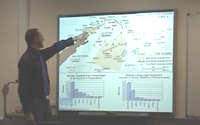
Watch the video extract showing the beginning and the end of Tarek's seminar presentation on 'The Language and Identity of the Berbers'. Look at the list below and select any good presentation techniques that Tarek uses. Then read the feedback.
To watch the video, click the play button once. You can move between parts of the video by dragging the slider left or right.
Select an option in the list by clicking on the check box next to it.
There is a transcript for you to look at if you need help while listening: Video transcript (pdf, 10kb).
Tarek uses all of the following good presentation techniques: Introduces the topic at the start of his presentation Interacts with his audience Makes eye contact with his audience Stands, and uses hand movements to help deliver the presentation Indicates what will follow later in his presentation Has interesting slides with clear and brief content Refers to specific slides in his presentation Indicates that his presentation is coming to an end Ends his presentation and invites questions
How did his use of these techniques help his presentation?
Tarek does not read his presentation aloud. Reading a presentation aloud is not recommended. It is much better to use your PowerPoint slides or a few notes to guide yourself as you speak. Your presentation will be more effective and more easily understood by your audience if it delivered naturally.
Watch the video extract again with the transcript above if you need to check your understanding. The parts of the transcript containing the answers to the listening task are highlighted.
How can different techniques help?
In this activity, you are going to think about how the use of different techniques can help when giving an oral presentation.
Instruction
Select a presentation technique from the list on left and then match it with the reason for using it in the list on the right. When you have selected and matched up all of the items, check your answers and read the feedback.
Click once on an item in the list on the left. This will highlight it. Then click once on a corresponding item on the right. A line will appear linking the two items together. Click on a different item on the right to change your selection and a new line will appear and replace the first line.
Use the reset button if you wish to begin the task again.
Here are the techniques correctly matched with their uses:
Make sure your presentation has an introduction, recognisable sections and a clear end. A clear structure will help the audience to understand better.
Use visual aids (PowerPoint slides or transparencies) to highlight the main points. Information that can be seen helps your audience's understanding of what they hear.
Reinforce important points by summarising them at the end of a section. This ensures the audience grasp the essential points that you want to communicate.
Check that visual aids do not have too much information and can be read easily. Visual aids need to be read easily and quickly while listening.
Have a 'live' rehearsal beforehand with a friend acting as the audience. This helps ensure that you can keep to time and will help you develop confidence.
Try to project your voice, speaking loudly enough to be heard. Voice control is important for your audience to be able to follow you.
Stand to deliver your presentation and try to use eye contact. It will help engage your audience in the topic if you are both clearly visible and looking at them.
Using techniques like these will help you give a more effective oral presentation if you are asked to give one during your course. You may be asked to give a joint presentation with another student, in which case you will need to organise carefully who does what.
Would you like to review the main points?
From these activities, you should now have a clear idea of what skills and preparation are needed in order to give a good oral presentation if you are asked to give one on your university course in the UK. Presenting effectively in a seminar requires good language control and communication skill, use of a range of presentation techniques and good management of time. By practising beforehand your confidence will also increase. A benefit of learning how to present effectively while on your course is that this skill is also likely to be useful to you later in your professional life.


 What skills are needed for presenting?
 Recognising good presentation techniques
 once. You can move between parts of the video by dragging the slider left or right.
 How can different techniques help?